Industrial Evaporative Condenser for Refrigeration Systems
An evaporative condenser is a heat rejection device designed to condense high-temperature refrigerant vapor through a combination of water evaporation and forced airflow. As spray water flows over the external surface of the condenser coils, part of the water evaporates and absorbs heat from the refrigerant inside the coils. The refrigerant is gradually cooled and condensed from vapor into liquid.
Compared with a conventional system using a separate condenser, cooling tower, circulating water pump and associated piping, an evaporative condenser integrates the main heat rejection components into a compact unit. This configuration can help reduce equipment footprint, piping requirements and installation complexity while supporting efficient heat transfer.
We provide evaporative condenser solutions for industrial refrigeration and heat rejection applications. Equipment configuration can be selected according to refrigerant type, heat rejection capacity, ambient conditions, water quality, power supply and installation requirements.
Key Advantages of the Evaporative Condenser
Efficient Heat Rejection
The evaporative condenser uses the latent heat absorption of water evaporation to remove heat from the refrigerant. The combination of spray water and forced airflow supports efficient heat transfer while maintaining stable condensation performance under suitable operating conditions.
The condenser coils are arranged in a compact cross-pattern along the airflow direction. This design increases the effective heat exchange area and improves interaction between the coil surface, circulating water and airflow.
Compact Integrated Design
The evaporative condenser integrates multiple components into one system, including:
By integrating these components, the system can reduce the need for separate cooling equipment and extensive connecting pipes. This helps simplify transportation, installation and maintenance while reducing the space required for the refrigeration heat rejection system.
Water and Energy Efficiency
Evaporative cooling uses water evaporation as an important part of the heat rejection process. Compared with systems that rely only on air-side heat transfer, this principle can provide effective heat rejection within a relatively compact equipment footprint.
The optimized spray system helps distribute water across the condenser coil, while the high-efficiency water eliminator reduces water carryover with the exhaust airflow. Water that does not evaporate is collected and recirculated through the system.
Actual water and energy consumption depends on heat rejection capacity, refrigerant type, ambient wet-bulb temperature, water quality, operating conditions and system configuration.
Corrosion-Resistant Coil Construction
The condenser coil and related components can be treated using high-temperature hot-dip galvanizing.
The zinc coating provides additional corrosion resistance for equipment operating in demanding industrial environments. The zinc coating thickness can reach more than 0.05 mm according to the applicable product configuration.
For projects located in coastal, high-humidity or otherwise corrosive environments, material selection and surface treatment should be evaluated according to actual site conditions.
Stable and Reliable Operation
The evaporative condenser is designed with multiple functional components to support continuous industrial operation. The axial flow fan provides the required airflow, while the spray system maintains water distribution over the condenser coils.
The integrated configuration also reduces the number of external connections, helping simplify system installation and reducing potential connection points.
How Does an Evaporative Condenser Work?
The operating principle is based on the combined effects of refrigerant condensation, water evaporation and forced airflow.
1. High-Temperature Refrigerant Enters the Coil
High-pressure and high-temperature refrigerant vapor enters the condenser coil after compression in the refrigeration system.
2. Cooling Water Is Distributed Over the Coil
The spray pump circulates water from the collection tank to the spray nozzles. The nozzles distribute water over the external surface of the condenser coils.
3. Water Evaporation Removes Heat
As air passes across the wet coil surface, a portion of the water evaporates. The evaporation process absorbs heat from the refrigerant through the condenser coil wall.
4. Refrigerant Condenses
As heat is continuously removed, the refrigerant temperature decreases and the refrigerant changes from vapor into liquid.
5. Water Is Collected and Recirculated
Water that does not evaporate falls into the collection tank and is circulated back to the spray system. The water eliminator helps reduce water droplets carried out of the condenser with the exhaust airflow.
Optimized Condenser Coil Design
The condenser coil is one of the key components affecting heat transfer performance.
The coil pipes are arranged in a compact cross-pattern along the airflow direction. This configuration increases the effective heat exchange area while maintaining suitable water distribution and airflow around the coil.
The condenser pipes are installed at a defined angle according to the refrigerant flow direction to facilitate refrigerant drainage after condensation.
Before shipment, condenser coils undergo pressure and airtightness testing according to the applicable manufacturing and quality-control requirements. For the relevant configuration, a 2.5 MPa airtightness test can be applied to verify coil integrity.
The coil assembly and related components are treated with hot-dip galvanizing to improve corrosion resistance and support long-term operation.
Main Components
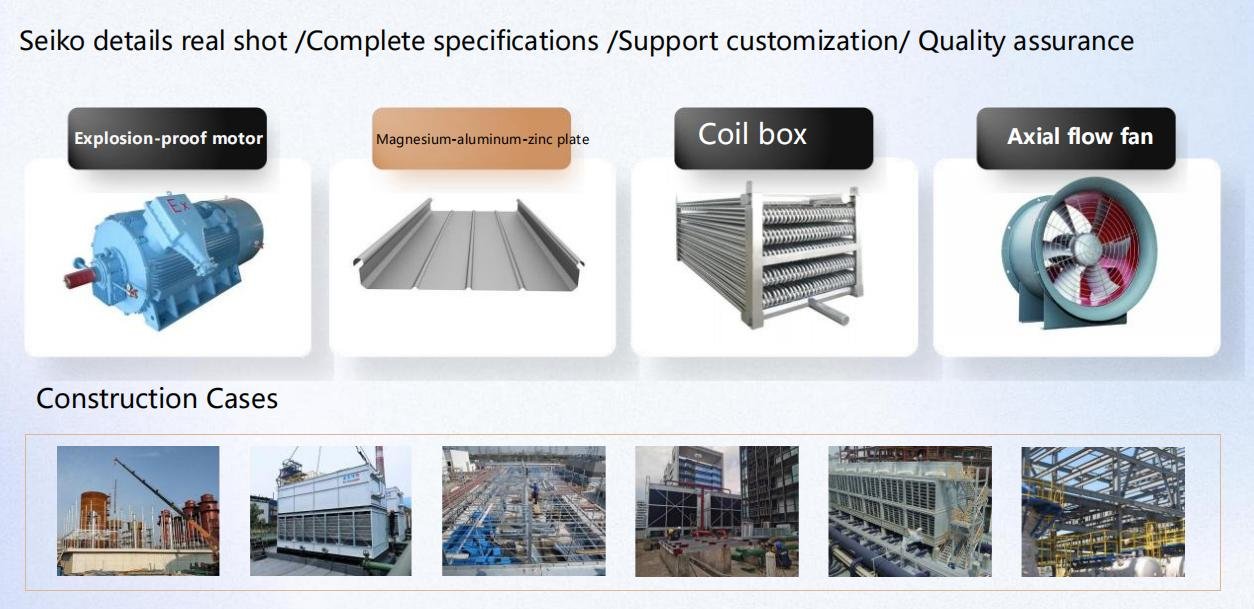
The evaporative condenser consists of several integrated components designed to work together as a complete heat rejection system.
Axial Flow Fan
Provides forced airflow through the condenser to support water evaporation and heat transfer.
Spray Nozzles
Distribute circulating water over the condenser coil to create an effective wet heat transfer surface.
Condenser Coil
Transfers heat from the refrigerant to the circulating water and airflow. The coil arrangement is optimized for efficient heat exchange and refrigerant drainage.
Water Circulation Pump
Circulates water from the collection tank to the spray distribution system.
High-Efficiency Water Eliminator
Reduces water droplets carried out of the condenser with the exhaust airflow, helping control water loss.
Water Collection Tank
Collects non-evaporated water for continuous circulation.
Electronic Water Descaling Device
Helps manage scale formation associated with circulating water and supports more stable equipment operation.
Filler and Supporting Components
Additional internal components support water distribution, airflow management and overall equipment operation.
Technical Specifications
Parameter | Specification |
Product Type | Industrial Evaporative Condenser |
Cooling Method | Evaporative Cooling |
Application | Industrial Refrigeration and Heat Rejection |
Refrigerant | Project Specific |
Heat Rejection Capacity | Customized |
Condensing Temperature | Project Specific |
Fan Type | Axial Flow Fan |
Coil Material | Galvanized Steel / Project Specific |
Coil Surface Treatment | Hot-Dip Galvanizing |
Water Circulation | Recirculating Spray Water |
Water Pump | Industrial Circulation Pump |
Water Eliminator | High-Efficiency Type |
Control System | Project Specific |
Power Supply | Customized |
Installation | Project Specific |
Equipment Configuration | Customized |
Note: Final equipment specifications should be determined according to the refrigeration load, refrigerant, ambient conditions, water quality and site requirements.
Applications
The industrial evaporative condenser can be integrated into refrigeration and heat rejection systems where efficient condensation and compact equipment configuration are required.
Cold Storage
Suitable for refrigeration systems used in cold storage facilities, refrigerated warehouses and temperature-controlled logistics.
Food Processing
Can be used for refrigeration and cooling systems in food processing facilities where reliable continuous heat rejection is required.
Industrial Refrigeration
Suitable for industrial refrigeration systems that require stable condenser performance and efficient heat rejection.
Process Cooling
Can be configured for suitable industrial process cooling applications where evaporative heat rejection is technically appropriate.
Large-Scale Refrigeration Projects
The integrated structure can be advantageous for projects with limited equipment space or where reducing external piping and installation complexity is important.
Considerations for Different Operating Environments
Southeast Asia
Industrial refrigeration systems operating in Southeast Asia may face high ambient temperatures, high humidity and variable water quality.
For these projects, evaporative condenser selection should consider local wet-bulb temperature, water quality, required heat rejection capacity, operating schedule and maintenance conditions.
Middle East
High ambient temperatures and water availability are important considerations for refrigeration projects in the Middle East.
Equipment selection should take into account the local wet-bulb temperature, water quality, evaporation rate, blowdown requirements and overall system operating conditions.
South America
Industrial projects across South America can involve different climatic conditions, electrical standards and water characteristics.
The condenser configuration should therefore be selected according to the actual project location, refrigerant system, heat rejection requirements, available power supply and installation environment.
How to Select an Evaporative Condenser
Choosing the correct evaporative condenser requires more than simply matching the refrigeration capacity.
Refrigerant Type
The refrigerant used in the refrigeration system should be confirmed before condenser selection.
Heat Rejection Capacity
Condenser sizing should be based on the required heat rejection load and the operating conditions of the refrigeration system.
Condensing Temperature
The required condensing temperature affects condenser sizing and overall refrigeration system performance.
Ambient Wet-Bulb Temperature
Wet-bulb temperature is an important factor because evaporative cooling performance depends on the ability of water to evaporate under local atmospheric conditions.
Water Quality
Water hardness, mineral content and other water characteristics can affect scaling, corrosion, maintenance requirements and operating performance.
Installation Space
Available installation area, airflow clearance, maintenance access and equipment orientation should be confirmed before final configuration.
Electrical Requirements
Voltage, frequency, motor power and control requirements should be confirmed according to the destination country and project specifications.
Custom Evaporative Condenser Solutions
Different refrigeration projects require different condenser configurations.
We can evaluate the equipment configuration according to project-specific requirements, including:
Providing these parameters at the quotation stage allows the technical team to recommend a more appropriate evaporative condenser configuration.
Quality Control and Testing
Reliable operation starts with controlled manufacturing and testing.
The condenser coil and major components are inspected during the manufacturing process. Coil pressure and airtightness testing is performed according to the applicable product and quality-control requirements before shipment.
Key inspection areas include:
Condenser coil integrity
Airtightness
Coil surface treatment
Spray nozzle installation
Water circulation components
Fan and motor assembly
Electrical components
Overall equipment assembly
For customized projects, inspection and testing requirements can be discussed according to the technical specification and destination market.
Why Choose us ?
We focus on industrial environmental and process equipment and provides engineered equipment configurations based on actual project requirements.
For evaporative condenser projects, the equipment can be evaluated according to refrigeration parameters, environmental conditions, water quality and installation requirements rather than using a one-size-fits-all configuration.
Our project support can include:
Equipment selection
Technical configuration
Customized design
Manufacturing
Quality inspection
Export packaging
Shipment coordination
Technical documentation
Frequently Asked Questions
What is an evaporative condenser?
An evaporative condenser is a heat rejection device that uses water evaporation and forced airflow to remove heat from refrigerant vapor and condense it into liquid.
What is the difference between an evaporative condenser and a cooling tower?
An evaporative condenser directly removes heat from the refrigerant through condenser coils. A cooling tower normally cools circulating water, which is then used by a separate condenser or heat exchanger.
Where are evaporative condensers used?
Evaporative condensers are commonly used in industrial refrigeration, cold storage, food processing, process cooling and other applications requiring efficient heat rejection.
Can an evaporative condenser be customized?
Yes. The equipment can be configured according to refrigerant type, heat rejection capacity, ambient conditions, water quality, power supply, installation space and other project requirements.
What information is required for an evaporative condenser quotation?
For accurate equipment selection, buyers should provide the refrigerant type, refrigeration capacity or heat rejection load, condensing temperature, ambient wet-bulb temperature, water conditions, power supply and installation requirements.
Is an evaporative condenser suitable for hot climates?
Evaporative condensers can be suitable for hot-climate applications, but the equipment must be selected according to local wet-bulb temperature, water availability, water quality and required heat rejection capacity.
Request an Evaporative Condenser Solution
Looking for an evaporative condenser for an industrial refrigeration project?
Send us your refrigeration system parameters and installation requirements. Our technical team can evaluate the operating conditions and recommend a suitable condenser configuration for your project.
Please Provide
Refrigerant type
Heat rejection capacity
Refrigeration capacity
Condensing temperature
Ambient temperature
Wet-bulb temperature
Water quality information
Power supply
Installation location
Required quantity
Share your parameters request then get Technical Recommendation and Quotation


