An industrial air cooler, also known as an air-cooled heat exchanger (ACHE), is designed to cool or condense process fluids by transferring heat to ambient air. The system uses finned tube bundles and axial fans to provide efficient air-to-fluid heat transfer without relying on cooling water for heat rejection.
Industrial air coolers are widely used for process cooling in chemical, petrochemical, oil and gas, power generation, mining, and other industrial applications. They are particularly suitable for facilities in water-scarce regions where reducing dependence on cooling-water systems is an important consideration.
The air cooler can be configured according to the process fluid, heat duty, inlet and outlet temperatures, flow rate, operating pressure, ambient temperature, material requirements, and installation conditions.
How Does an Industrial Air Cooler Work?
An industrial air cooler operates through air-to-fluid heat transfer. Hot process fluid flows through the finned tube bundle while ambient air passes over the external surfaces of the tubes.
Axial fans generate the required airflow across the finned tube bundle. Heat is transferred from the process fluid through the tube wall and fins into the surrounding air, reducing the temperature of the process fluid before it returns to the process system or enters the next stage of production.
The actual cooling performance depends on heat duty, process-fluid properties, flow rate, inlet and outlet temperatures, ambient temperature, airflow rate, tube and fin configuration, and other project-specific conditions.
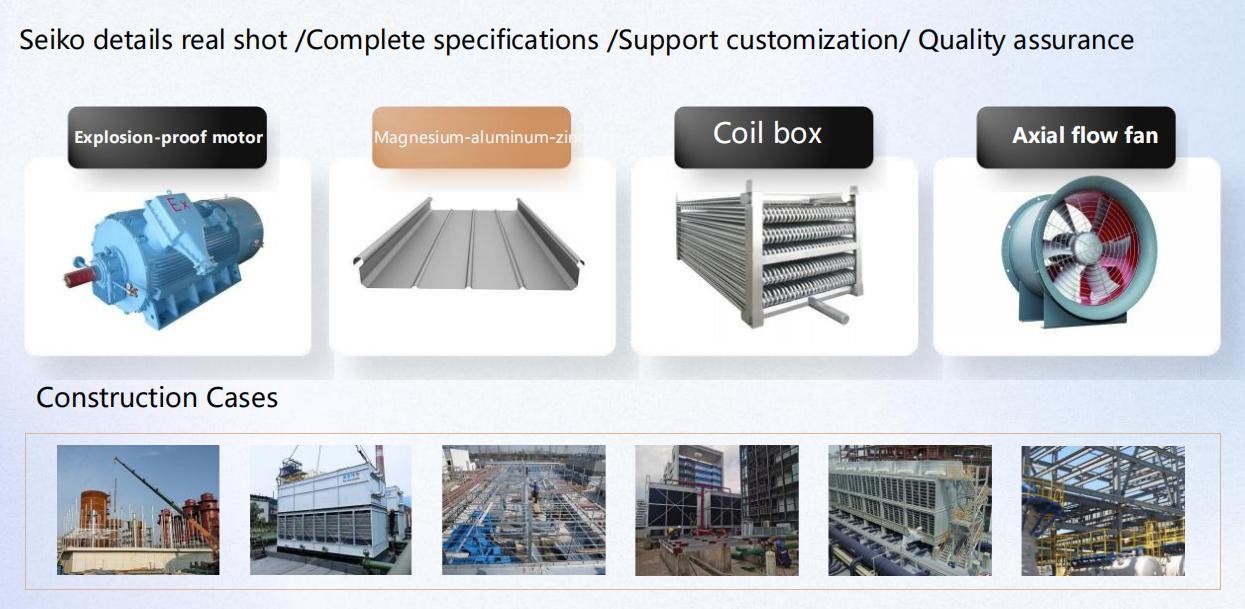
Key Advantages of Industrial Air Coolers
Reduced Dependence on Cooling Water
An industrial air cooler uses ambient air as the primary cooling medium, reducing the need for cooling water during the heat-rejection process. This can help reduce dependence on cooling-water circulation, makeup water, and associated water-treatment infrastructure.
This feature makes air-cooled heat exchangers an attractive option for industrial facilities where water availability is limited or where reducing industrial water consumption is an important consideration.
Efficient Finned Tube Heat Transfer
The air cooler uses finned tube bundles to increase the external heat-transfer surface area. The finned structure promotes efficient heat dissipation between the process fluid and ambient air while allowing the heat exchanger to be configured according to the required cooling duty.
Tube and fin configurations can be selected according to the process medium, operating temperature, ambient conditions, corrosion requirements, and project specifications.
Suitable for Water-Scarce Regions
Air-cooled heat exchangers can be particularly suitable for industrial facilities located in water-constrained areas. By using ambient air for heat rejection, they can reduce the dependence on cooling-water infrastructure.
This makes air coolers suitable for selected process cooling applications in the Middle East, Southeast Asia, South America, and other regions where water availability and operating conditions need to be considered during cooling-system design.
Flexible Industrial Configuration
The air cooler can be configured according to the actual process requirements rather than relying on a fixed standard design.
Key considerations include heat duty, process-fluid flow rate, inlet and outlet temperatures, operating pressure, ambient temperature, airflow requirements, available installation space, and material selection.
Modular Tube Bundle Design
The tube bundle can adopt a modular structure to support equipment assembly, transportation, installation, and maintenance. The heat-transfer configuration can be adjusted according to the required cooling capacity and project conditions.
Designed for Industrial Operation
With appropriate material selection, airflow design, equipment sizing, and regular maintenance, an industrial air cooler can provide stable heat removal for continuous process cooling applications.
Finned Tube Bundle for Efficient Heat Transfer
The finned tube bundle is one of the main heat-transfer components of an industrial air cooler.
Fins increase the external heat-transfer surface area of the tubes, allowing heat from the process fluid to be transferred more effectively to ambient air. The tube and fin materials can be selected according to the process fluid, operating temperature, corrosion conditions, ambient environment, and required heat-transfer performance.
The tube bundle configuration can be engineered according to the required heat duty, airflow conditions, installation space, and application requirements.
Axial Fan and Airflow Design
Axial fans provide the airflow required to remove heat from the finned tube bundle.
The airflow system is designed according to the required cooling capacity, ambient temperature, equipment configuration, installation environment, and available space. Proper airflow distribution helps maintain effective heat transfer across the tube bundle and supports stable operating conditions.
Fan capacity, airflow direction, fan arrangement, and other configuration details should be determined according to the actual project requirements.
Industrial Applications
Chemical Processing
Industrial air coolers can be used for selected process cooling and condensation applications in chemical plants where reliable heat removal and reduced dependence on cooling water are required.
Petrochemical Industry
Air-cooled heat exchangers can be integrated into petrochemical process systems for cooling or condensing process fluids where air-based heat rejection is suitable for the operating conditions.
Oil and Gas
Air coolers can be considered for selected oil and gas process cooling applications, particularly at facilities where cooling-water availability or water consumption is an important design consideration.
Power Generation
Air-cooled heat exchangers can support selected process and auxiliary cooling requirements in power-generation facilities, subject to the required thermal and operating conditions.
Mining and Mineral Processing
Mining and mineral-processing facilities may benefit from air-cooled heat exchange where cooling-water infrastructure is limited, particularly for remote industrial sites.
Industrial Manufacturing
Air coolers can be integrated into industrial manufacturing systems that require continuous process cooling or heat removal and where ambient-air cooling is suitable.
Air Cooler vs. Water-Cooled Heat Exchanger
An air cooler and a water-cooled heat exchanger use different cooling media and have different installation requirements.
Factor | Industrial Air Cooler | Water-Cooled Heat Exchanger |
Primary cooling medium | Ambient air | Cooling water |
Cooling-water requirement | Little or none for heat rejection | Required |
Water treatment | Reduced requirement | Usually required |
Water-scarce locations | Suitable | May require additional water infrastructure |
Ambient temperature impact | Significant | Generally lower |
Main maintenance focus | Fans fins and tube bundles | Tubes water circuit and associated equipment |
Installation considerations | Requires sufficient airflow and space | Requires cooling-water circulation |
Typical applications | Process cooling and condensation | Industrial process cooling |
The appropriate cooling technology should be selected according to heat duty, process conditions, ambient temperature, water availability, installation space, maintenance requirements, and overall project objectives.
Technical Data
Item | Specification |
Product Type | Industrial Air Cooler |
Heat Exchanger Type | Air-Cooled Heat Exchanger |
Cooling Medium | Ambient Air |
Process Medium | Customized |
Heat Duty | Project-Specific |
Process Flow Rate | Project-Specific |
Inlet Temperature | Project-Specific |
Outlet Temperature | Project-Specific |
Operating Pressure | Project-Specific |
Tube Material | Selected According to Application |
Fin Material | Selected According to Application |
Fan Type | Axial Fan |
Airflow Configuration | Project-Specific |
Installation | Indoor or Outdoor |
Application | Process Cooling and Condensation |
Actual specifications should be confirmed according to the customer's process conditions and project requirements.
Air Cooler Selection Guide
Selecting an industrial air cooler requires consideration of both process conditions and the installation environment.
Process Fluid
The type and basic properties of the liquid or gas to be cooled should be provided to determine suitable heat-transfer and material requirements.
Heat Duty
Required heat duty is a key factor in determining the required heat-transfer capacity and overall equipment configuration.
Inlet and Outlet Temperatures
The process-fluid inlet temperature and required outlet temperature determine the required cooling performance under the specified ambient conditions.
Flow Rate
Process flow rate affects heat transfer, pressure drop, and equipment sizing.
Operating Pressure
Operating pressure should be considered when determining the tube and heat-exchanger configuration.
Ambient Temperature
Ambient temperature is particularly important for an air-cooled heat exchanger because surrounding air is used as the cooling medium. Site design temperature should therefore be considered during equipment selection.
Installation Conditions
Available space, equipment orientation, airflow conditions, maintenance access, and environmental exposure should be evaluated before finalizing the equipment configuration.
Material Requirements
Tube and fin materials should be selected according to process-fluid properties, operating temperature, pressure, corrosion conditions, and expected service environment.
Custom Industrial Air Cooler Solutions
Every industrial cooling application has different process conditions. An air cooler should therefore be selected according to the actual heat duty, process medium, operating conditions, ambient environment, and installation requirements.
We can evaluate the available process data and recommend a suitable air-cooled heat exchanger configuration for the application.
The engineering evaluation may consider:
Process fluid and flow rate
Heat duty
Inlet and outlet temperatures
Operating pressure
Ambient temperature
Tube and fin materials
Fan and airflow configuration
Equipment dimensions
Installation conditions
Maintenance requirements
Customers can provide the process information currently available, and our technical team can help identify the key parameters required for preliminary air cooler selection.
Engineering Support for Industrial Cooling Projects
For industrial cooling projects, equipment selection should be based on actual operating conditions rather than a standard configuration.
We can evaluate process requirements, operating conditions, ambient environment, material requirements, airflow, installation space, and other project factors when determining a suitable air-cooled heat exchanger configuration.
For project inquiries, customers can provide available process data, equipment requirements, drawings, or site information for technical evaluation.
Frequently Asked Questions
What is an industrial air cooler?
An industrial air cooler is an air-cooled heat exchanger that uses ambient air to remove heat from process fluids. It is commonly used for industrial process cooling and condensation.
Is an air cooler the same as an air-cooled heat exchanger?
In many industrial applications, the terms “air cooler” and “air-cooled heat exchanger” refer to the same basic type of equipment, which uses finned tubes and airflow to transfer heat from a process fluid to ambient air.
Does an air cooler require cooling water?
The main heat-rejection process does not require cooling water because ambient air is used as the cooling medium. This can reduce dependence on cooling-water systems.
Are air coolers suitable for hot climates?
Air coolers can be used in hot climates, but ambient temperature must be carefully considered during equipment selection. Higher ambient temperatures can affect the achievable process-fluid outlet temperature, so the equipment should be sized according to actual site conditions.
Are air coolers suitable for water-scarce regions?
Yes. Reducing dependence on cooling water is one of the main advantages of air-cooled heat exchangers, making them suitable for selected industrial applications in water-constrained regions.
What industries use industrial air coolers?
Common applications include chemical processing, petrochemical, oil and gas, power generation, mining, mineral processing, and industrial manufacturing.
What information is required to select an air cooler?
Important information normally includes the process fluid, flow rate, heat duty, inlet and outlet temperatures, operating pressure, ambient temperature, installation conditions, and material requirements.
Can an industrial air cooler be customized?
Yes. The configuration can be evaluated according to process conditions, heat duty, ambient environment, material requirements, airflow requirements, and installation conditions.
Need an Industrial Air Cooler for Your Process?
Tell us your process requirements, and our technical team can help evaluate a suitable air-cooled heat exchanger configuration.
You can provide the process fluid, flow rate, inlet and outlet temperatures, heat duty, operating pressure, ambient temperature, and installation requirements for preliminary evaluation.
Request an Air Cooler Solution
Share Your Process Data


