
Ru

Electroplating Wastewater Treatment for Gravure Plate Roller Manufacturing
September 22, 2026
Heavy Metal Wastewater Treatment, Water Reuse and Zero Liquid Discharge Solution
A gravure plate roller manufacturer generates wastewater from its electroplating processes. The wastewater contains different metal pollutants, including chromium, copper and nickel, requiring targeted treatment before reuse or final disposal.
The customer wanted to improve wastewater management, recover treated water for reuse and ultimately achieve a Zero Liquid Discharge (ZLD) objective.
Because the wastewater streams had different characteristics, a treatment system based on wastewater separation and customized physicochemical treatment was selected.
Project Challenges
The main challenge was the presence of different types of electroplating wastewater generated during the production process.
The wastewater containing chromium, copper and nickel needed to be properly collected and separated before treatment. Treating these streams without considering their different characteristics could make the subsequent treatment process more difficult to control.
The customer therefore required a solution that could:
· Handle different electroplating wastewater streams
· Separate chromium-, copper- and nickel-containing wastewater
· Provide stable physicochemical treatment
· Remove pollutants through precipitation and filtration
· Recover treated water for reuse
· Further reduce liquid wastewater through evaporation
· Support the customer's Zero Liquid Discharge objective
Customized Treatment Solution
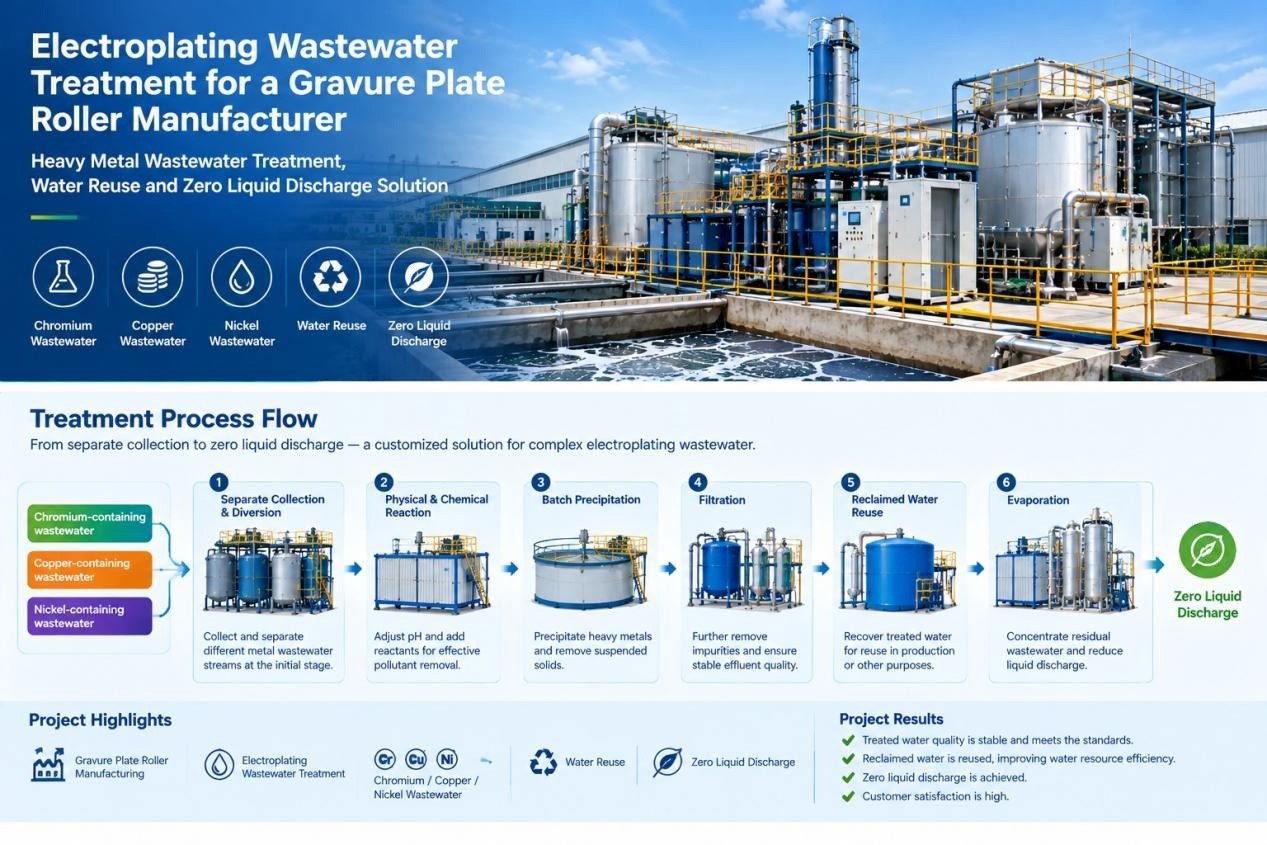
Based on the wastewater characteristics and the customer's treatment objectives, the wastewater streams were collected separately at the initial stage and treated through quality separation and diversion.
The main treatment process included physical and chemical reaction, batch precipitation, filtration, reclaimed water reuse and evaporation.
Treatment Process
Chromium-Containing Wastewater
Copper-Containing Wastewater
Nickel-Containing Wastewater
↓
Separate Collection & Diversion
↓
Physical & Chemical Reaction
↓
Batch Precipitation
↓
Filtration
↓
Reclaimed Water Reuse
↓
Evaporation
↓
Zero Liquid Discharge Objective
The process configuration was designed around the characteristics of the different wastewater streams rather than applying a single treatment process to all wastewater.
Key Treatment Technologies
1. Wastewater Separation and Diversion
Chromium-, copper- and nickel-containing wastewater was separately collected during the early stage of the treatment process.
This allowed different wastewater streams to be managed according to their individual characteristics and treatment requirements.
2. Physical & Chemical Treatment
Physical and chemical reactions were used as the primary treatment stage to condition the wastewater and facilitate the removal of pollutants.
3. Batch Precipitation
The wastewater was treated through batch precipitation to separate pollutants from the liquid phase.
The resulting solids were then separated from the treated water through subsequent filtration.
4. Filtration
Filtration provided an additional solid-liquid separation stage after precipitation, helping produce stable treated water quality for subsequent reuse.
5. Reclaimed Water Reuse
After treatment and filtration, reclaimed water was recovered for reuse, helping reduce the amount of wastewater requiring final disposal.
6. Evaporation
An evaporation stage was incorporated to further reduce liquid wastewater and support the customer's Zero Liquid Discharge objective.
Project Results
The completed treatment system achieved the customer's main wastewater management objectives.
Stable Treated Water Quality
The treated effluent quality remained stable and met the required standards.
Water Reuse
Treated water was recovered for reuse, supporting the customer's goal of improving water utilization.
Zero Liquid Discharge
The combination of wastewater separation, physicochemical treatment, precipitation, filtration, water reuse and evaporation enabled the project to achieve the customer's Zero Liquid Discharge objective.
Customer Satisfaction
The treatment system delivered stable operation and satisfactory treatment results, resulting in a high level of customer satisfaction.
Project Highlights
Item | Project Information |
Industry | Gravure Plate Roller Manufacturing |
Application | Electroplating Wastewater Treatment |
Main Wastewater | Chromium-, Copper- and Nickel-Containing Wastewater |
Main Treatment | Physical & Chemical Reaction + Batch Precipitation + Filtration |
Water Management | Reclaimed Water Reuse |
Final Treatment | Evaporation |
Treatment Objective | Zero Liquid Discharge |
Result | Stable Effluent Quality and Compliance with Required Standards |
Why Wastewater Separation Matters in Electroplating Treatment
Electroplating wastewater is not necessarily a uniform wastewater stream. Different plating processes can generate wastewater with different chemical characteristics.
In this project, separating chromium-, copper- and nickel-containing wastewater at the collection stage allowed the treatment process to be better adapted to the characteristics of each wastewater stream.
This project demonstrates an important principle for industrial wastewater treatment:
The right treatment system starts with understanding the wastewater, not simply selecting equipment based on flow rate.
A Customized Approach to Electroplating Wastewater Treatment
For electroplating and metal surface treatment facilities, wastewater treatment requirements can vary according to:
· Plating processes
· Types of metals used
· Wastewater composition
· Wastewater flow rate
· Required discharge standards
· Water reuse requirements
· Sludge management requirements
· Zero Liquid Discharge requirements
For this reason, We can develop electroplating wastewater treatment solutions according to the customer's actual wastewater characteristics and project objectives.
The treatment configuration may include wastewater separation, physicochemical treatment, precipitation, filtration, water reuse and evaporation, depending on the specific application.
Looking for an Electroplating Wastewater Treatment Solution?
If your factory generates wastewater containing chromium, copper, nickel or other heavy metals, We can evaluate your wastewater characteristics and treatment objectives to develop a customized solution.
For a preliminary technical assessment, please provide:
· Wastewater analysis
· Daily wastewater flow rate
· Main plating processes
· Main pollutants and heavy metals
· Required discharge standard
· Water reuse requirements
· Zero Liquid Discharge requirements
· Project location
Contact us to discuss your electroplating wastewater treatment project.
Inquiry now